Co-Op
Compliance
Checker

My role: Product lead and hands-on builder. I identified a recurring approval bottleneck and used Base44 to turn the solution into a working internal product.

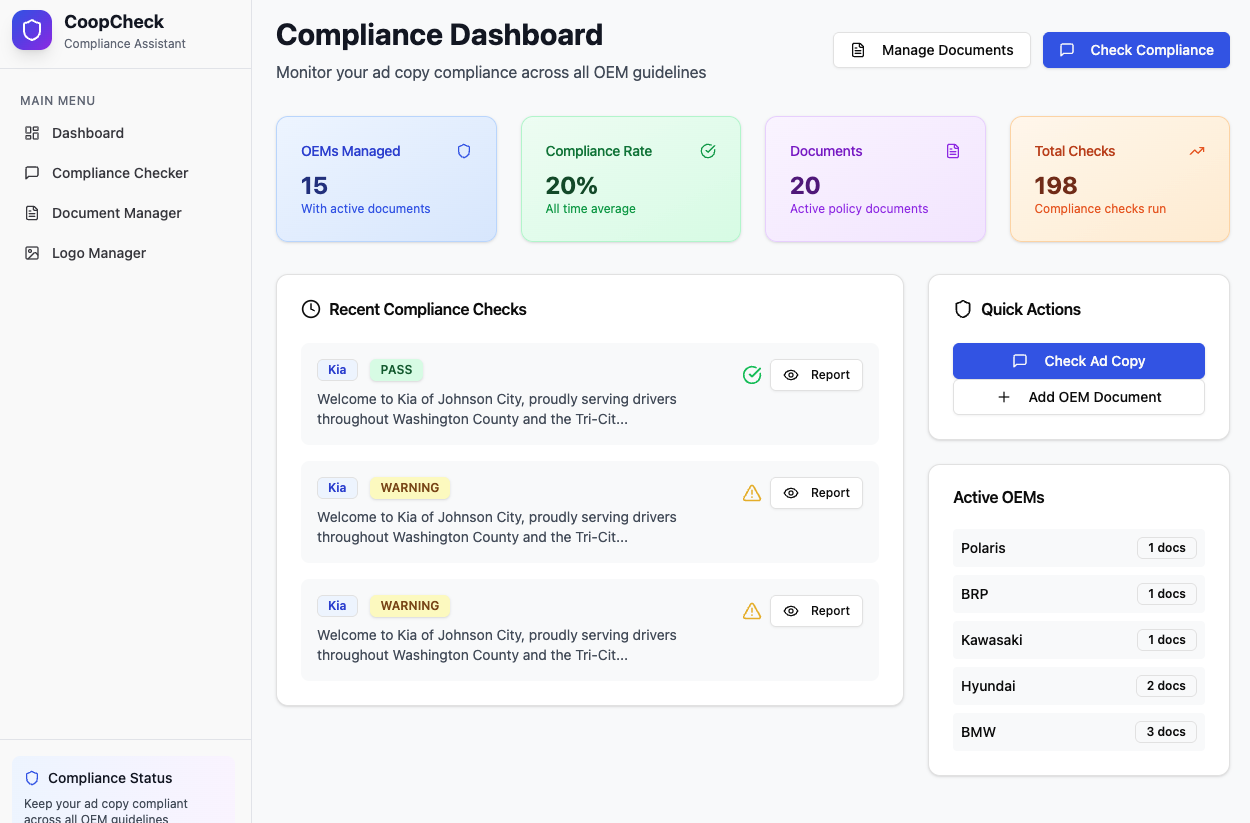
The outcome: One platform for automotive-manufacturer guidelines, approved assets, AI-assisted review, and pre-submission confidence scoring—helping the team improve first-pass approvals from 15% to 95% during the measured rollout.

Co-Op Compliance Checker dashboard built with Base44
Built with Base44 15% → 95% first-pass approval
PRODUCT SIGNAL
>IDENTIFY • BUILD IN BASE44 • VALIDATE • ADOPT_

Role & Scope

01 / OWNERSHIP

From operational problem to usable product

I framed the product opportunity, designed the review workflow, organized the source material, built the application in Base44, and worked with production users to validate whether the tool surfaced useful issues before submission.

The goal was not to replace human judgment. It was to give teams a faster, more consistent first review and put the information needed for a decision in one place.

The Challenge

02 / WHAT WAS BROKEN

Compliance feedback arrived too late

Teams searched across disconnected manufacturer documents, logo folders, disclaimers, and prior feedback before submitting creative for approval. Important issues were often discovered only after submission.

That created avoidable revisions, production delays, and repeated communication. The problem was not a lack of information; it was the absence of a usable system around it.

The Base44 Build

Why Base44 made the product possible

I chose Base44 because it let me move directly from workflow design to a functioning internal application. Instead of stopping at a requirements document or static prototype, I could build the experience, put it in front of users, and improve it around real production needs.

Base44 became the application layer that brought the product together: the interface, organized compliance knowledge, review flow, and results experience all lived in one usable system.

Move quickly

Turn the concept into a working product early enough to test the workflow, not just discuss it.

Keep ownership close

Iterate on the product without turning every workflow change into a separate engineering request.

Design for adoption

Give production users one clear interface instead of another collection of documents and folders.

How It Worked

01 / SELECT

Start with the manufacturer

The user selected the automotive manufacturer, bringing the relevant guidelines, disclaimers, approved logos, and prior compliance knowledge into the review context.

02 / REVIEW

Analyze the draft

The Base44 application guided an AI-assisted review against brand requirements and historical rejection patterns, highlighting areas that needed attention before submission.

03 / EXPLAIN

Show the reason, not only the score

The workflow surfaced potential concerns alongside supporting information so the production team could understand what to change and apply professional judgment.

04 / DECIDE

Keep people in control

The confidence score acted as a decision-support signal, not an automatic approval. Users reviewed the findings, corrected the creative, and remained responsible for the final submission.

Impact

03 / MEASURED ROLLOUT

Issues moved earlier in the workflow

The Base44 product gave production users a repeatable pre-submission review, faster access to the right compliance information, and clearer visibility into likely concerns.

During the measured rollout, first-pass approval increased from 15% to 95%. Just as importantly, the team shifted from discovering problems through external rejection to identifying them while there was still time to act.

15%Previous first-pass approval
95%First-pass approval in measured rollout
EarlierCompliance issue detection
OneCentral review workspace

What Base44 unlocked

Rapid product iteration, direct user feedback, and a single interface for a workflow that had previously been spread across documents, assets, inboxes, and tribal knowledge.

Explore more product work

This project shows how I use emerging tools pragmatically: start with a real operational problem, choose the fastest responsible path to a usable product, and measure whether it improves the work.